Research Breaks Down 3 Gender Differences in Leadership Expectations

by | Sep 1, 2023 | Female Leadership, Mindset

The key to being perceived as a formidable leader? Juggle communal leadership styles with unwavering self-esteem and self-confidence. It's a superpower that can empower you to navigate the complex world of leadership successfully.

As you dive headfirst into the professional world, let’s chat about something crucial: self-confidence in women’s leadership. It’s a topic that’s gained spotlight, especially with Virginia Rometty becoming IBM’s first female CEO. Her journey reflects the importance of self-confidence, and we’re here to break it down for you, drawing wisdom from Leslie Pratch’s research.

Self-Confidence and Success: The Perfect Pair

Picture this: you’ve just snagged your dream job, brimming with knowledge and enthusiasm. But, here’s the catch – that little voice inside your head starts whispering, “Do I really belong here?” Don’t fret; we’ve all been there.

The Self-Confidence Gender Gap: Insights from Pratch

Leslie Pratch’s research in assessing executives for top roles uncovers a pivotal component of success – self-confidence. Her journey, dating back to the ’90s at the University of Chicago Booth School of Business, aimed to unveil long-term predictors of leadership, exploring the intricate connections between gender, coping strategies, and motivation in gauging leadership prowess.

Surprising Gender Differences in Coping

One of Pratch’s most striking findings was the gender-based disparity in active coping mechanisms. While both men and women demonstrated active coping, its impact on leadership effectiveness differed based on gender. The core measure of active coping, signaling adaptability under stress, emerged as a critical predictor for both genders.

Breaking Down the Gender Divide

But here’s where it gets interesting: when Pratch delved into the components of active coping, she uncovered noteworthy gender-based distinctions:

    1. Taking on External Challenges: This measure, about facing challenges head-on and externalizing them, was a significant predictor of leadership for women but not so much for men.

    2. No to Defensive Vagueness: This metric, assessing resistance to vague and ambiguous communication, played a substantial role in women’s leadership effectiveness but not in men’s.

    3. The Power of Self-Confidence: Interestingly, a measure gauging self-confidence and self-esteem significantly correlated with leadership among women but didn’t carry the same weight for men.

Gender-Based Expectations and Leadership Styles

Expectations rooted in gender heavily influence leadership styles. Women often lean towards communal qualities, emphasizing affiliation, empathy, spontaneity, and emotional expressiveness. In contrast, men are encouraged to exhibit agentic traits, like independence, assertiveness, and instrumental competence.

Leadership Styles and Gender Roles

These expectations translate into leadership styles – women are expected to lead collaboratively (interpersonally oriented), while men’s leadership is seen as more task-oriented and dominant. When women leaders adopt a more masculine style, they risk amplifying role conflicts and facing unfair evaluations.

The Freedom of Male Leaders

Male leaders, on the other hand, experience fewer role conflicts because leadership expectations align with societal beliefs about male behavior. Men are often free to express leadership in various styles without encountering backlash. Notably, self-confidence is a trait expected from male leaders, and Pratch’s findings suggest it doesn’t significantly predict judgments of men’s leadership.

The Call for Self-Confidence in Women Leaders

So, what’s the takeaway for women leaders? To be seen as effective leaders, they must strike a balance between communal leadership styles and unwavering self-confidence. This unique ability to navigate challenges confidently while leading in a communal manner empowers women to transcend constraints often placed on their leadership style.

Conclusion: Embrace Your Superpower

In a nutshell, Pratch’s research shines a light on the distinctive challenges faced by women leaders. The key to being perceived as a formidable leader? Juggle communal leadership styles with unwavering self-esteem and self-confidence. It’s a superpower that can empower you to navigate the complex world of leadership successfully. Virginia Rometty’s journey stands as a testament to these qualities in action, showcasing how self-confidence can truly transform the realm of women’s leadership. So, recent grad, remember: you have what it takes; own your journey with confidence!


<a href="https://www.executiveinsider.org/author/blogauthor19/" target="_self">EI Insights Blog</a>
EI Insights Blog
As co-founder of Executive Insider, Torah Bontrager brings a unique blend of entrepreneurial, nonprofit, and AI expertise to her work, focused on overcoming the challenges faced by first-generation professionals (FGPs). She architects the holistic infusion of artificial intelligence throughout the RISE curriculum's pedagogy. As co-founder of Executive Insider, May Teo is an educator, mentor, and curriculum designer dedicated to advancing the careers of First-Generation Female Professionals. She leads the development of the RISE curriculum, a multi-tiered leadership pathway that equips women to transition from survival mode to visible, impactful leadership.

Hi First Generation Female Professional!

Are You Trapped in the GAP™?

Join our community of trailblazing women

. . . where we celebrate diversity and welcome your unique perspective.

Related Posts

The Cohort-Based RISE Fellowship

Our 18-month RISE Fellowship is a four-phase journey that transitions FGPs from career survival to sustainable leadership and legacy. Through sequenced curricula in Career Ownership, Strategic Navigation, Leading with Impact, and Community Building, we provide the critical support needed at every stage of a first-generation female professional's career.

Our fellowship is not a one-time course but a sustained journey. Each tier builds upon the previous to facilitate lasting transformation.

GOAL: TRANSITION FROM GRATEFUL WORKER → CAREER CEO

Tier 1: RISE Foundation Curriculum (Career Ownership)

This 90-day tier equips FGPs with the confidence, tools, and energy strategies to claim ownership of their careers. Every module leverages AI, teaching Fellows how to use artificial intelligence for energy stewardship and to reduce invisible labor.
GOAL: TRANSITION FROM EARLY PROFESSIONAL → STRATEGIC NAVIGATOR

Tier 2: RISE Advancement Curriculum (Strategic Navigation)

This 90-day tier equips FGPs to navigate politics, gain sponsorship, and practice strategic visibility in professional arenas. Every module leverages AI, teaching Fellows how to use artificial intelligence to simulate high-stakes environments, analyze complex networks, and refine strategic communication to build confidence before real-world execution.
GOAL: TRANSITION FROM STRATEGIC NAVIGATOR → VISIBLE LEADER WHO SHAPES SYSTEMS

Tier 3: RISE Leadership & Legacy Curriculum (Leading with Impact)

This 90-day tier equips FGPs to embrace leadership roles, mentor others, and design careers with lasting impact. Every module leverages AI, teaching Fellows how to use artificial intelligence to refine their leadership voice, model sustainable practices, and prototype systemic change, validating that their impact is both profound and enduring.
GOAL: TRANSITION FROM LEADER → TRAILBLAZER & COMMUNITY BUILDER

Tier 4: RISE Trailblazer Alumni Curriculum (Community Builders)

This 90-day tier equips FGPs to serve as mentors, advocates, and ambassadors who strengthen the ecosystem for future FGPs. Every module leverages AI, teaching Fellows how to use artificial intelligence to scale their mentorship, amplify their advocacy, and safeguard their sustainability, positioning their legacy to create a lasting cycle of empowerment for the next generations.

Fully-Funded by Our Generous Partners

Thanks to the support of our grantmakers and sponsors, the RISE Fellowship is offered at no cost to all selected FGPs, facilitating equitable access and opportunity for every Fellow.

Program Impact

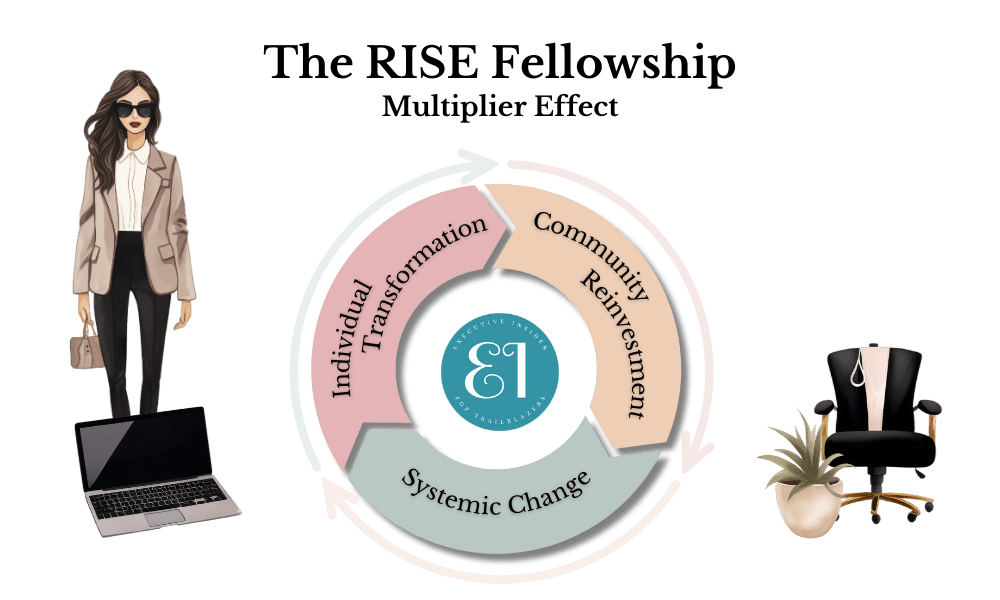
The RISE Fellowship is designed to deliver a measurable return on investment, transforming communities and individual careers and strengthening the talent pipeline with first-generation women (FGPs). Our layered evaluation strategy tracks both quantitative and qualitative outcomes, so we capture the full depth of each Fellow's journey through the 18-month pathway.

Cross-Tier Impact & Economic Mobility Metrics

Within one year of completing their Fellowship, we project that our Fellows will achieve tangible career milestones that directly contribute to closing the wage and opportunity gap:

Promotion & Raise Rate: Over 50% of Fellows will report a promotion, significant raise, or transition to a more advanced role.

Network Growth: 70% will report a measurable strengthening of their professional support network.

Confidence in Advocacy: 85% will report increased confidence in negotiating salary, promotions, and scope of work.