3 Tips to Networking Smarter, Not Harder As a Young Female

by | Sep 4, 2023 | Mindset

Men typically don't need the kind of gender-related information that women do in male-dominated industries. So, as you venture into your career, remember that networking isn't just about collecting contacts. It's about understanding how to position yourself in your network strategically.

As you navigate the professional world, you’re probably hearing a lot about the importance of networking. It’s a buzzword for a reason: it can significantly impact your career path. But did you know that networking isn’t a one-size-fits-all game? Research by Brian Uzzi sheds light on how networking strategies differ between men and women, and it’s crucial to understand these differences as you navigate your career journey.

The Power of Networks in Professional Life

You’ve likely heard that your network can open doors to opportunities, and that’s absolutely true. But what Brian Uzzi’s research reveals is that not all networks are created equal, especially when it comes to gender.

Men vs. Women: The Network Divide

It’s no secret that there’s a gender gap when it comes to leadership positions. Men tend to dominate these roles, and Uzzi’s research dives into why that happens. What he found is fascinating: it’s not just about the size of your network; it’s about how you’re positioned within it.

Men: Central Players in the Network Game

For men, being at the center of their network is a significant advantage. What does that mean? Imagine your network as a web of connections. If you’re in the middle of this web, you have quick access to a wide range of information – job opportunities, salary insights, and more. Men who master this centrality tend to land higher-paying jobs with more authority.

Women: It’s About More Than Just Centrality

While centrality also benefits women in their job search, there’s an intriguing twist. Women who aim for executive positions with real authority and great pay need something extra – a close-knit circle of female contacts. This inner circle provides private information about organizations’ attitudes toward female leaders, giving women the edge in job interviews and negotiations.

Why the Difference?

The need for this inner circle among women arises from the unique challenges they face in the workplace. Cultural and political hurdles often put them at a disadvantage, and having this supportive network can make all the difference.

The Inner Circle That Works

Not all inner circles are created equal. Uzzi’s research found that the most successful women had inner circles where women were closely connected to each other but had minimal common contacts. This structure allowed for a wealth of diverse insights and opportunities.

Men’s Networks: It’s All Business

Interestingly, the gender composition of men’s networks didn’t significantly impact their job placement. Men typically don’t need the kind of gender-related information that women do in male-dominated industries.

Networking Smarter, Not Harder

So, what can you learn from this research? How can you make your network work for you?

    1. Quality Over Quantity: It’s not about how many people you know, but who those people are. Identify and connect with individuals who have broad connections.

    2. Embrace Randomness: Don’t limit yourself to similar-minded individuals. Randomly connecting with people from diverse backgrounds can broaden your horizons.

    3. Avoid a Closed Inner Circle: While a close-knit group feels secure, it might not provide the insights and opportunities you need. Diversify your inner circle to stay informed.

A Path Forward for Women

This research shows that women may face a greater challenge in networking for professional opportunities. However, by adopting smart networking strategies, they can continue to find meaningful career advancements and support others in their journey.

So, as you venture into your career, remember that networking isn’t just about collecting contacts. It’s about understanding how to position yourself in your network strategically. With the right approach, you can break down barriers and thrive in your chosen field. Happy networking!

<a href="https://www.executiveinsider.org/author/blogauthor19/" target="_self">EI Insights Blog</a>
EI Insights Blog
As co-founder of Executive Insider, Torah Bontrager brings a unique blend of entrepreneurial, nonprofit, and AI expertise to her work, focused on overcoming the challenges faced by first-generation professionals (FGPs). She architects the holistic infusion of artificial intelligence throughout the RISE curriculum's pedagogy. As co-founder of Executive Insider, May Teo is an educator, mentor, and curriculum designer dedicated to advancing the careers of First-Generation Female Professionals. She leads the development of the RISE curriculum, a multi-tiered leadership pathway that equips women to transition from survival mode to visible, impactful leadership.

Hi First Generation Female Professional!

Are You Trapped in the GAP™?

Join our community of trailblazing women

. . . where we celebrate diversity and welcome your unique perspective.

Related Posts

The Cohort-Based RISE Fellowship

Our 18-month RISE Fellowship is a four-phase journey that transitions FGPs from career survival to sustainable leadership and legacy. Through sequenced curricula in Career Ownership, Strategic Navigation, Leading with Impact, and Community Building, we provide the critical support needed at every stage of a first-generation female professional's career.

Our fellowship is not a one-time course but a sustained journey. Each tier builds upon the previous to facilitate lasting transformation.

GOAL: TRANSITION FROM GRATEFUL WORKER → CAREER CEO

Tier 1: RISE Foundation Curriculum (Career Ownership)

This 90-day tier equips FGPs with the confidence, tools, and energy strategies to claim ownership of their careers. Every module leverages AI, teaching Fellows how to use artificial intelligence for energy stewardship and to reduce invisible labor.
GOAL: TRANSITION FROM EARLY PROFESSIONAL → STRATEGIC NAVIGATOR

Tier 2: RISE Advancement Curriculum (Strategic Navigation)

This 90-day tier equips FGPs to navigate politics, gain sponsorship, and practice strategic visibility in professional arenas. Every module leverages AI, teaching Fellows how to use artificial intelligence to simulate high-stakes environments, analyze complex networks, and refine strategic communication to build confidence before real-world execution.
GOAL: TRANSITION FROM STRATEGIC NAVIGATOR → VISIBLE LEADER WHO SHAPES SYSTEMS

Tier 3: RISE Leadership & Legacy Curriculum (Leading with Impact)

This 90-day tier equips FGPs to embrace leadership roles, mentor others, and design careers with lasting impact. Every module leverages AI, teaching Fellows how to use artificial intelligence to refine their leadership voice, model sustainable practices, and prototype systemic change, validating that their impact is both profound and enduring.
GOAL: TRANSITION FROM LEADER → TRAILBLAZER & COMMUNITY BUILDER

Tier 4: RISE Trailblazer Alumni Curriculum (Community Builders)

This 90-day tier equips FGPs to serve as mentors, advocates, and ambassadors who strengthen the ecosystem for future FGPs. Every module leverages AI, teaching Fellows how to use artificial intelligence to scale their mentorship, amplify their advocacy, and safeguard their sustainability, positioning their legacy to create a lasting cycle of empowerment for the next generations.

Fully-Funded by Our Generous Partners

Thanks to the support of our grantmakers and sponsors, the RISE Fellowship is offered at no cost to all selected FGPs, facilitating equitable access and opportunity for every Fellow.

Program Impact

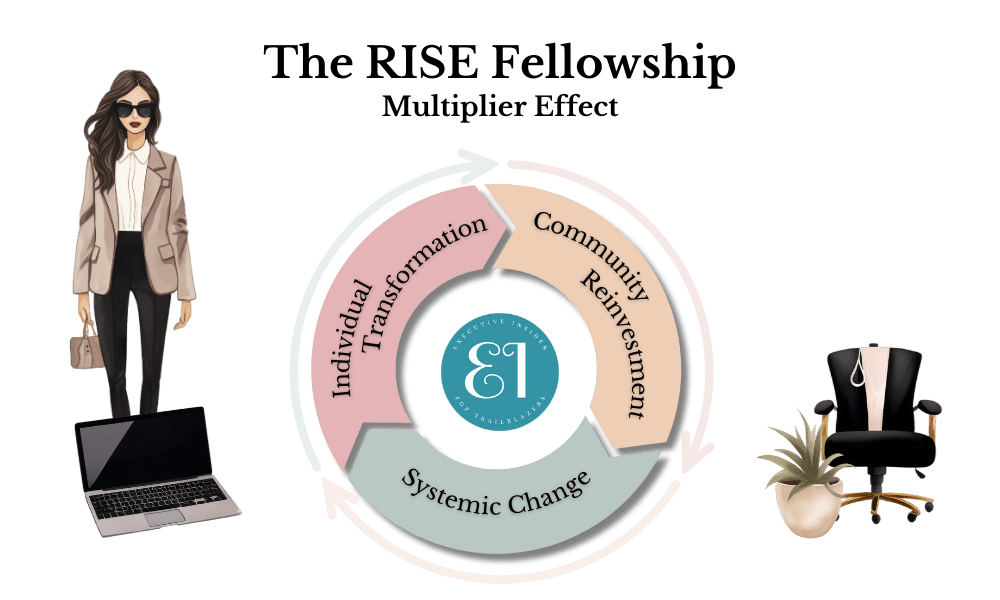
The RISE Fellowship is designed to deliver a measurable return on investment, transforming communities and individual careers and strengthening the talent pipeline with first-generation women (FGPs). Our layered evaluation strategy tracks both quantitative and qualitative outcomes, so we capture the full depth of each Fellow's journey through the 18-month pathway.

Cross-Tier Impact & Economic Mobility Metrics

Within one year of completing their Fellowship, we project that our Fellows will achieve tangible career milestones that directly contribute to closing the wage and opportunity gap:

Promotion & Raise Rate: Over 50% of Fellows will report a promotion, significant raise, or transition to a more advanced role.

Network Growth: 70% will report a measurable strengthening of their professional support network.

Confidence in Advocacy: 85% will report increased confidence in negotiating salary, promotions, and scope of work.