Beyond Fight or Flight: The Strategic Strength of Women’s Stress Response

by | Dec 4, 2025 | Mindset, Productivity

For decades, the "fight or flight" response defined our understanding of stress. But research shows a more nuanced, communal pattern for women: "tend and befriend." For first-gen female professionals, this isn't just a biological fact. It's a strategic advantage in leadership and resilience that we've likely been leveraging our entire careers.

The “fight or flight” model has long dominated our understanding of stress. But what if this framework, largely based on male-centric research, only tells half the story? A study by Taylor et al. (2000) showed that women often exhibit a different, equally powerful response: “tend and befriend.” In times of stress, we are biologically and psychologically wired to protect our loved ones and strengthen our social alliances.

This isn’t a weakness. Instead, it’s a sophisticated survival strategy that has significant implications for how we lead, especially as first-gen professionals who have always had to build our own support systems.

Tend and Befriend in the Modern Workplace

This response isn’t confined to personal crises. We saw it demonstrated by female leaders and organizations during the global pandemic. While the business world often rewards aggressive, competitive tactics, the “tend and befriend” model fostered a different kind of leadership—one focused on resilience, collective well-being, and pragmatic support.

Organizations like the Women Presidents’ Organization became great examples. Their members went from fear to action, offering one another not just emotional support, but tangible resources like pro-bono work and strategic advice. This is the “tend and befriend” response operationalized: building a collective safety net that enables entire communities to endure and thrive.

Why This Matters for the First-Gen Leader

As first-gen professionals, we often lack inherited safety nets. The “tend and befriend” instinct is the engine behind the powerful, self-made networks we build. It’s the reason we intuitively create “inner circles” and support systems. This research validates that our approach isn’t merely a soft skill. It’s a critical, strategic asset that fosters loyalty, collaboration, and sustainable success in the face of adversity.

Furthermore, this understanding helps reframe our own stress responses. Feeling the urge to connect with colleagues or nurture your team during a high-pressure project isn’t a distraction; it’s a source of strength. It’s a leadership style that builds trust and creates environments where people—and businesses—can perform under pressure.

Leveraging Your Built-In Resilience

The challenge for first-gen women is often not our response to stress, but the systems that fail to recognize its value. By consciously leveraging our “tend and befriend” tendencies, we can:

  • Build Cohesive, High-Functioning Teams: Create cultures of mutual support that reduce burnout and increase retention.
  • Forge Powerful Strategic Alliances: Use our networking strength to build resilient, reciprocal professional communities.
  • Lead with Authenticity: Embrace a leadership model that aligns with our innate strengths, rather than forcing a style that doesn’t fit.

Your inclination to connect, support, and build community in the face of challenges isn’t a deviation from leadership. For the modern, complex workplace, it is quite possibly its future.

Sources

Taylor, S. E., Klein, L. C., Lewis, B. P., Gruenewald, T. L., Gurung, R. A. R., & Updegraff, J. A. (2000). Biobehavioral responses to stress in females: Tend-and-befriend, not fight-or-flight. Psychological Review, 107(3), 411–429. https://doi.org/10.1037/0033-295X.107.3.411

<a href="https://www.executiveinsider.org/author/blogauthor19/" target="_self">EI Insights Blog</a>
EI Insights Blog
As co-founder of Executive Insider, Torah Bontrager brings a unique blend of entrepreneurial, nonprofit, and AI expertise to her work, focused on overcoming the challenges faced by first-generation professionals (FGPs). She architects the holistic infusion of artificial intelligence throughout the RISE curriculum's pedagogy. As co-founder of Executive Insider, May Teo is an educator, mentor, and curriculum designer dedicated to advancing the careers of First-Generation Female Professionals. She leads the development of the RISE curriculum, a multi-tiered leadership pathway that equips women to transition from survival mode to visible, impactful leadership.

Hi First Generation Female Professional!

Are You Trapped in the GAP™?

Join our community of trailblazing women

. . . where we celebrate diversity and welcome your unique perspective.

Related Posts

The Cohort-Based RISE Fellowship

Our 18-month RISE Fellowship is a four-phase journey that transitions FGPs from career survival to sustainable leadership and legacy. Through sequenced curricula in Career Ownership, Strategic Navigation, Leading with Impact, and Community Building, we provide the critical support needed at every stage of a first-generation female professional's career.

Our fellowship is not a one-time course but a sustained journey. Each tier builds upon the previous to facilitate lasting transformation.

GOAL: TRANSITION FROM GRATEFUL WORKER → CAREER CEO

Tier 1: RISE Foundation Curriculum (Career Ownership)

This 90-day tier equips FGPs with the confidence, tools, and energy strategies to claim ownership of their careers. Every module leverages AI, teaching Fellows how to use artificial intelligence for energy stewardship and to reduce invisible labor.
GOAL: TRANSITION FROM EARLY PROFESSIONAL → STRATEGIC NAVIGATOR

Tier 2: RISE Advancement Curriculum (Strategic Navigation)

This 90-day tier equips FGPs to navigate politics, gain sponsorship, and practice strategic visibility in professional arenas. Every module leverages AI, teaching Fellows how to use artificial intelligence to simulate high-stakes environments, analyze complex networks, and refine strategic communication to build confidence before real-world execution.
GOAL: TRANSITION FROM STRATEGIC NAVIGATOR → VISIBLE LEADER WHO SHAPES SYSTEMS

Tier 3: RISE Leadership & Legacy Curriculum (Leading with Impact)

This 90-day tier equips FGPs to embrace leadership roles, mentor others, and design careers with lasting impact. Every module leverages AI, teaching Fellows how to use artificial intelligence to refine their leadership voice, model sustainable practices, and prototype systemic change, validating that their impact is both profound and enduring.
GOAL: TRANSITION FROM LEADER → TRAILBLAZER & COMMUNITY BUILDER

Tier 4: RISE Trailblazer Alumni Curriculum (Community Builders)

This 90-day tier equips FGPs to serve as mentors, advocates, and ambassadors who strengthen the ecosystem for future FGPs. Every module leverages AI, teaching Fellows how to use artificial intelligence to scale their mentorship, amplify their advocacy, and safeguard their sustainability, positioning their legacy to create a lasting cycle of empowerment for the next generations.

Fully-Funded by Our Generous Partners

Thanks to the support of our grantmakers and sponsors, the RISE Fellowship is offered at no cost to all selected FGPs, facilitating equitable access and opportunity for every Fellow.

Program Impact

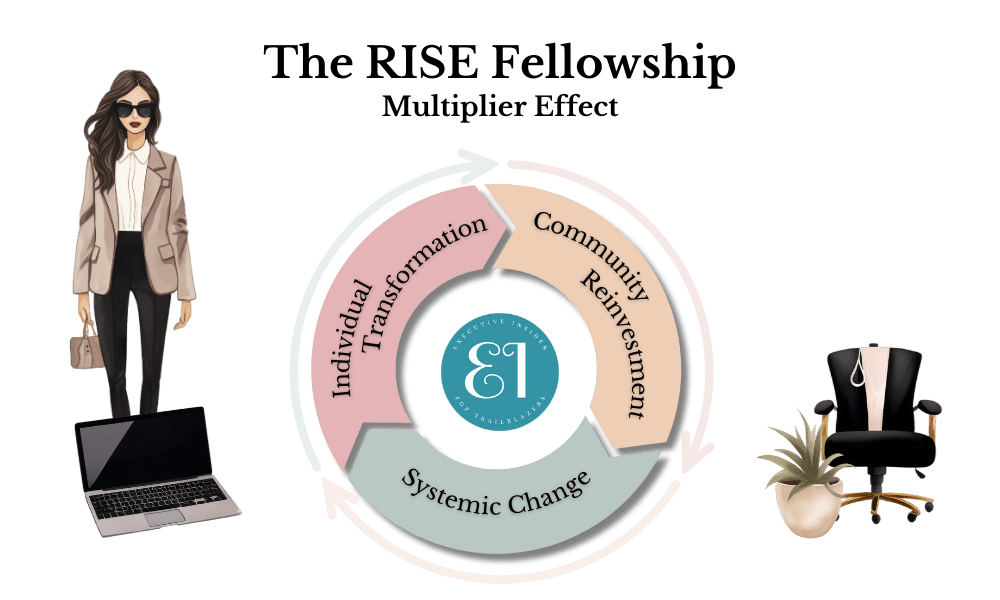
The RISE Fellowship is designed to deliver a measurable return on investment, transforming communities and individual careers and strengthening the talent pipeline with first-generation women (FGPs). Our layered evaluation strategy tracks both quantitative and qualitative outcomes, so we capture the full depth of each Fellow's journey through the 18-month pathway.

Cross-Tier Impact & Economic Mobility Metrics

Within one year of completing their Fellowship, we project that our Fellows will achieve tangible career milestones that directly contribute to closing the wage and opportunity gap:

Promotion & Raise Rate: Over 50% of Fellows will report a promotion, significant raise, or transition to a more advanced role.

Network Growth: 70% will report a measurable strengthening of their professional support network.

Confidence in Advocacy: 85% will report increased confidence in negotiating salary, promotions, and scope of work.