Who’s Building AI? Why Women Still Don’t Show Up Where It Matters

by | Apr 16, 2026 | Artificial Intelligence (AI), Productivity

This policy briefing shows that women are still underrepresented in AI, overqualified for the roles they do hold, and missing from the leadership table where the future is being built.

You don’t need to wait for AI to become “for everyone.” You need to make sure you’re part of the group shaping what “everyone” means.

What the Article Actually Says

Young et al. (2021) found that women make up only 22% of AI and data science professionals globally and 20% in the UK, with the gap widening in more technical and senior roles. They also found that women are more likely to work in lower-status data roles, leave the field at higher rates, and appear less often on major online platforms and research networks that shape influence in AI.

Their briefing argues that the problem is not just representation; it’s also data transparency, pay equity, job quality, and governance. The recommendations call for disaggregated reporting, intersectional data collection, gender-inclusive labor policies, and intentional inclusion of women in technical and leadership roles.

Visibility in AI Is Career Capital

For first-generation female professionals (FGPs), AI can seem like a future you’re expected to adapt to quickly, even when the people designing it don’t reflect you. Young et al.’s 2021 policy briefing shows that women are still underrepresented across AI and data science, making up just 22% of the global workforce in those fields and 20% in the UK (Young et al., 2021). That’s not a small gap. It’s a structural warning sign.

The gender gap in AI isn’t just about numbers. Women are more likely than men to hold lower-status roles in analytics, data preparation, and exploration, while men are more concentrated in engineering and machine learning—the roles more likely to shape product direction, compensation, and visibility (Young et al., 2021). In other words, women are present, but often not where the leverage is.

That matters for FGPs, because visibility in AI is career capital. If you’re not seen as technical, strategic, or future-facing, it becomes harder to earn trust, transition into leadership, or shape the systems your organization relies on. The briefing also found that women in AI and data science have higher turnover and attrition rates in tech, which suggests the issue isn’t just access. It’s retention, climate, and advancement.

The most telling part of the briefing may be the mismatch between education and role. Women in AI and data science often have higher formal qualifications than men, especially in senior ranks, yet they remain underrepresented in C-suite positions. That should land hard for any FGP who’s ever felt over-prepared and under-recognized. It means credentials alone don’t close the gap. We also need sponsorship, networks, and systems that translate expertise into opportunity.

Young et al. (2021) also found that men self-report more skills on LinkedIn than women, across industries and countries, while women are underrepresented on major platforms like Kaggle, Stack Overflow, and Google Scholar. That’s not just a confidence issue. It’s also a signal problem. If you don’t name your skills, publish your work, or show up where your field’s credibility is being built, someone else will define the story for you.

What This Means for You, Right Now

It means AI literacy is no longer optional, but neither is self-advocacy. Learn the tools. Name your skills. Put your work where it can be seen. If you’re in a nontechnical role, build fluency so you can speak with confidence about how AI affects strategy, operations, and ethics. If you’re already technical, make sure your contributions are visible beyond the back end.

The policy briefing also makes a broader case that governments and employers need to collect better data, enforce reporting standards, and include women in the design of AI systems themselves. That aligns closely with Executive Insider’s theory of change: we can’t fix what we won’t measure, and we can’t democratize opportunity if women keep being left out of the rooms where the rules are written.

For FGPs, the practical lesson is both sobering and empowering. Sobering, because the gap is real. Empowering, because once you can see the pattern, you can navigate it more deliberately. You don’t need to wait for AI to become “for everyone.” You need to make sure you’re part of the group shaping what “everyone” means.

Your Next Step

Choose one AI skill, one visible platform, and one relationship that can increase your credibility in the field this quarter.

Sources

Young, E., Wajcman, J., & Sprejer, L. (2021). Where are the women? Mapping the gender job gap in AI. The Alan Turing Institute. https://www.turing.ac.uk/news/publications/report-where-are-women-mapping-gender-job-gap-ai

<a href="https://www.executiveinsider.org/author/blogauthor19/" target="_self">EI Insights Blog</a>
EI Insights Blog
As co-founder of Executive Insider, Torah Bontrager brings a unique blend of entrepreneurial, nonprofit, and AI expertise to her work, focused on overcoming the challenges faced by first-generation professionals (FGPs). She architects the holistic infusion of artificial intelligence throughout the RISE curriculum's pedagogy. As co-founder of Executive Insider, May Teo is an educator, mentor, and curriculum designer dedicated to advancing the careers of First-Generation Female Professionals. She leads the development of the RISE curriculum, a multi-tiered leadership pathway that equips women to transition from survival mode to visible, impactful leadership.

Hi First Generation Female Professional!

Are You Trapped in the GAP™?

Join our community of trailblazing women

. . . where we celebrate diversity and welcome your unique perspective.

Related Posts

The Cohort-Based RISE Fellowship

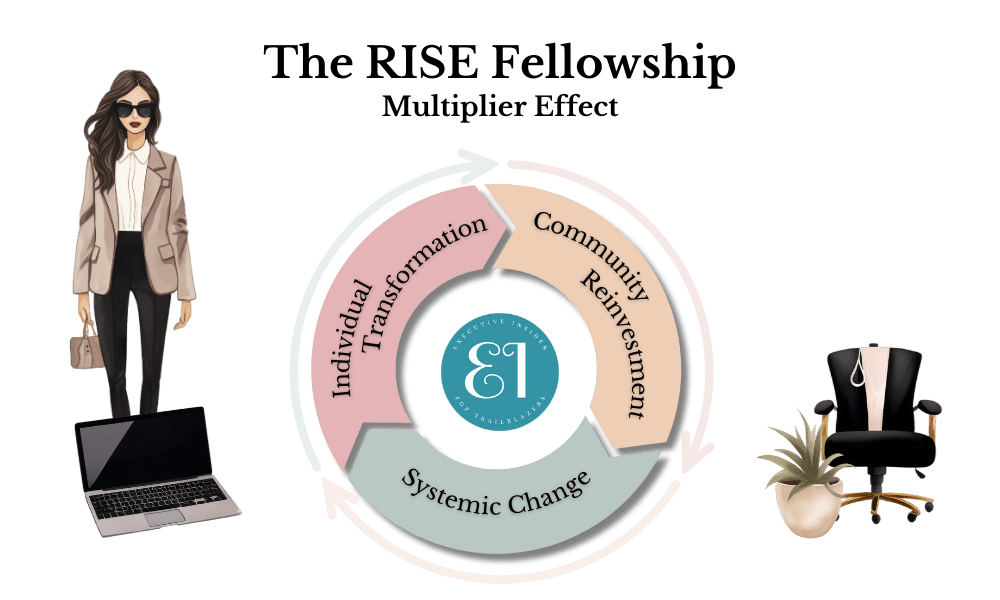
Our 18-month RISE Fellowship is a four-phase journey that transitions FGPs from career survival to sustainable leadership and legacy. Through sequenced curricula in Career Ownership, Strategic Navigation, Leading with Impact, and Community Building, we provide the critical support needed at every stage of a first-generation female professional's career.

Our fellowship is not a one-time course but a sustained journey. Each tier builds upon the previous to facilitate lasting transformation.

GOAL: TRANSITION FROM GRATEFUL WORKER → CAREER CEO

Tier 1: RISE Foundation Curriculum (Career Ownership)

This 90-day tier equips FGPs with the confidence, tools, and energy strategies to claim ownership of their careers. Every module leverages AI, teaching Fellows how to use artificial intelligence for energy stewardship and to reduce invisible labor.
GOAL: TRANSITION FROM EARLY PROFESSIONAL → STRATEGIC NAVIGATOR

Tier 2: RISE Advancement Curriculum (Strategic Navigation)

This 90-day tier equips FGPs to navigate politics, gain sponsorship, and practice strategic visibility in professional arenas. Every module leverages AI, teaching Fellows how to use artificial intelligence to simulate high-stakes environments, analyze complex networks, and refine strategic communication to build confidence before real-world execution.
GOAL: TRANSITION FROM STRATEGIC NAVIGATOR → VISIBLE LEADER WHO SHAPES SYSTEMS

Tier 3: RISE Leadership & Legacy Curriculum (Leading with Impact)

This 90-day tier equips FGPs to embrace leadership roles, mentor others, and design careers with lasting impact. Every module leverages AI, teaching Fellows how to use artificial intelligence to refine their leadership voice, model sustainable practices, and prototype systemic change, validating that their impact is both profound and enduring.
GOAL: TRANSITION FROM LEADER → TRAILBLAZER & COMMUNITY BUILDER

Tier 4: RISE Trailblazer Alumni Curriculum (Community Builders)

This 90-day tier equips FGPs to serve as mentors, advocates, and ambassadors who strengthen the ecosystem for future FGPs. Every module leverages AI, teaching Fellows how to use artificial intelligence to scale their mentorship, amplify their advocacy, and safeguard their sustainability, positioning their legacy to create a lasting cycle of empowerment for the next generations.

Fully-Funded by Our Generous Partners

Thanks to the support of our grantmakers and sponsors, the RISE Fellowship is offered at no cost to all selected FGPs, facilitating equitable access and opportunity for every Fellow.

Program Impact

The RISE Fellowship is designed to deliver a measurable return on investment, transforming communities and individual careers and strengthening the talent pipeline with first-generation women (FGPs). Our layered evaluation strategy tracks both quantitative and qualitative outcomes, so we capture the full depth of each Fellow's journey through the 18-month pathway.

Cross-Tier Impact & Economic Mobility Metrics

Within one year of completing their Fellowship, we project that our Fellows will achieve tangible career milestones that directly contribute to closing the wage and opportunity gap:

Promotion & Raise Rate: Over 50% of Fellows will report a promotion, significant raise, or transition to a more advanced role.

Network Growth: 70% will report a measurable strengthening of their professional support network.

Confidence in Advocacy: 85% will report increased confidence in negotiating salary, promotions, and scope of work.