She Measured What No One Was Counting: A Lesson in Data-Backed Advocacy

by | Mar 12, 2026 | Community Engagement, Responsible AI

A Harvard biostatistician turned independent health-impact data into a tool communities are using to challenge AI infrastructure permits, one gas turbine at a time.

If you’ve ever sat in a meeting sensing that a decision would hurt people who had no voice in the room, this article gives you a model: find the number, name the community, bring both to the table.

What the Article Actually Says

This Q&A profiles Dr. Michael Cork, a Harvard-trained biostatistician who quantifies the real dollar and human cost of air pollution from AI data centers powered by fossil fuels (Feldscher, 2026). Cork’s analyses of the Vantage Data Center in Loudoun County, Virginia, estimated between $53 million and $99 million in annual health damages, driven primarily by 3.4 to 6.5 additional premature deaths per year in the surrounding region, one of the largest single-facility health-damage estimates produced to date.

Cork also examined the proposed xAI Gas Plant near Memphis and found the communities most likely to bear the burden already carry high social vulnerability, elevated asthma rates, and lower median household income, a pattern he traced directly into a community town hall in Memphis (Feldscher, 2026). His central argument is that fine particulate matter drives nearly 90% of air pollution’s health impact, yet it’s rarely factored into energy or climate assessments, meaning permitting decisions for data centers routinely get made without any accounting of their public health costs.

Measuring Invisible Costs

Dr. Cork’s work proves a point that matters far beyond public health: you can’t fix what you refuse to measure. His research turned an invisible cost, air pollution from AI infrastructure, into a concrete number that regulators, journalists, and residents could actually use (Feldscher, 2026).

For first-generation female professionals (FGPs), this is a masterclass in a skill many of us have had to build without a manual: converting a felt injustice into evidence someone in power has to respond to. Cork’s Fluvanna County analysis reportedly shaped a Planning Commission’s vote to deny a gas plant expansion. That’s not a hypothetical outcome; that’s data changing a decision.

What This Means for You, Right Now

You don’t need a PhD in biostatistics to apply this lesson. If you’ve ever sat in a meeting sensing that a decision would hurt people who had no voice in the room, this article gives you a model: find the number, name the community, bring both to the table. Cork’s team didn’t just publish findings; they co-founded a consulting group and brought results directly to a community town hall, closing the gap between research and real people.

That approach scales across career stages. Early-career FGPs building credibility can borrow this instinct by backing up instincts with data before raising concerns in a meeting; it’s the difference between “I have a bad feeling about this” and “here’s what the numbers show.” Mid-to-late-career FGPs moving into executive, board, or oversight roles can use Cork’s framing, treat health and environmental costs as real costs, not externalities, as language for pushing more rigorous vendor and infrastructure evaluations (Feldscher, 2026).

Why This Matters for FGPs (First-Gen Female Professionals)

This story aligns directly with Executive Insider’s mission because it shows economic equity and AI literacy converging in real time. Cork’s research repeatedly found that the communities absorbing the highest health costs also had the lowest household incomes, exactly the wage and opportunity gap our theory of change exists to close.

We know you don’t have the luxury of assuming someone else will measure the invisible costs affecting your community. Cork’s story is proof that one person’s rigor, applied consistently, can shift a permitting vote, a town hall conversation, or a company’s decision-making. That’s the kind of quiet, evidence-driven leadership we want every FGP in our community to see as fully within reach.

Your Next Step

The next time you sense a decision at work is overlooking real consequences for real people, borrow Cork’s method: ask what data exists, and if it doesn’t, ask who could produce it. Naming the gap is often the first act of leadership, long before you have all the answers.

Sources

Feldscher, K. (2026, April 8.) Analyzing air pollution health, economic risks from AI data centers. Harvard School of Public Health. https://hsph.harvard.edu/news/analyzing-air-pollution-health-economic-risks-from-ai-data-centers

<a href="https://www.executiveinsider.org/author/blogauthor19/" target="_self">EI Insights Blog</a>
EI Insights Blog
As co-founder of Executive Insider, Torah Bontrager brings a unique blend of entrepreneurial, nonprofit, and AI expertise to her work, focused on overcoming the challenges faced by first-generation professionals (FGPs). She architects the holistic infusion of artificial intelligence throughout the RISE curriculum's pedagogy. As co-founder of Executive Insider, May Teo is an educator, mentor, and curriculum designer dedicated to advancing the careers of First-Generation Female Professionals. She leads the development of the RISE curriculum, a multi-tiered leadership pathway that equips women to transition from survival mode to visible, impactful leadership.

Hi First Generation Female Professional!

Are You Trapped in the GAP™?

Join our community of trailblazing women

. . . where we celebrate diversity and welcome your unique perspective.

Related Posts

The Cohort-Based RISE Fellowship

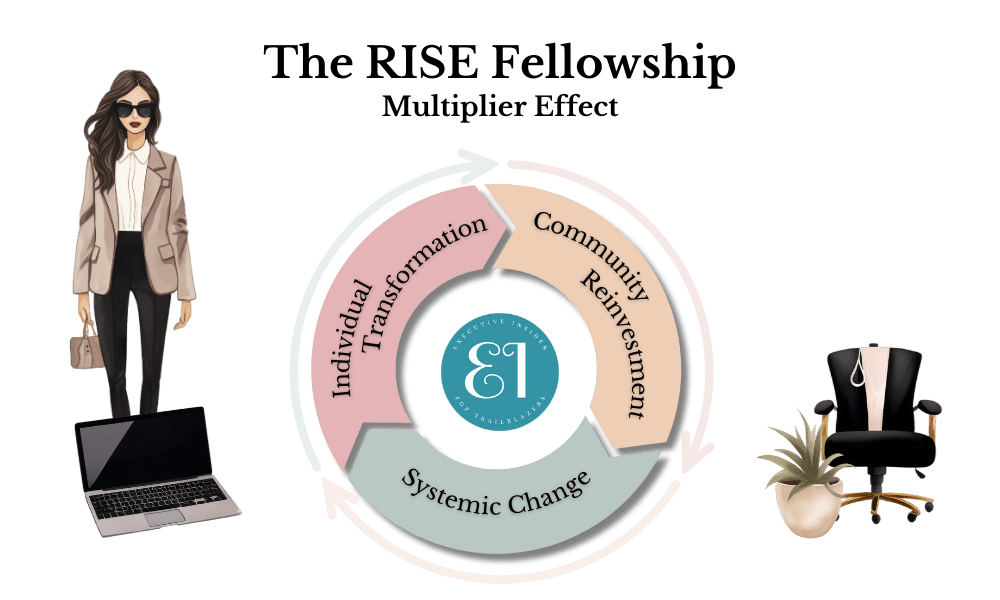
Our 18-month RISE Fellowship is a four-phase journey that transitions FGPs from career survival to sustainable leadership and legacy. Through sequenced curricula in Career Ownership, Strategic Navigation, Leading with Impact, and Community Building, we provide the critical support needed at every stage of a first-generation female professional's career.

Our fellowship is not a one-time course but a sustained journey. Each tier builds upon the previous to facilitate lasting transformation.

GOAL: TRANSITION FROM GRATEFUL WORKER → CAREER CEO

Tier 1: RISE Foundation Curriculum (Career Ownership)

This 90-day tier equips FGPs with the confidence, tools, and energy strategies to claim ownership of their careers. Every module leverages AI, teaching Fellows how to use artificial intelligence for energy stewardship and to reduce invisible labor.
GOAL: TRANSITION FROM EARLY PROFESSIONAL → STRATEGIC NAVIGATOR

Tier 2: RISE Advancement Curriculum (Strategic Navigation)

This 90-day tier equips FGPs to navigate politics, gain sponsorship, and practice strategic visibility in professional arenas. Every module leverages AI, teaching Fellows how to use artificial intelligence to simulate high-stakes environments, analyze complex networks, and refine strategic communication to build confidence before real-world execution.
GOAL: TRANSITION FROM STRATEGIC NAVIGATOR → VISIBLE LEADER WHO SHAPES SYSTEMS

Tier 3: RISE Leadership & Legacy Curriculum (Leading with Impact)

This 90-day tier equips FGPs to embrace leadership roles, mentor others, and design careers with lasting impact. Every module leverages AI, teaching Fellows how to use artificial intelligence to refine their leadership voice, model sustainable practices, and prototype systemic change, validating that their impact is both profound and enduring.
GOAL: TRANSITION FROM LEADER → TRAILBLAZER & COMMUNITY BUILDER

Tier 4: RISE Trailblazer Alumni Curriculum (Community Builders)

This 90-day tier equips FGPs to serve as mentors, advocates, and ambassadors who strengthen the ecosystem for future FGPs. Every module leverages AI, teaching Fellows how to use artificial intelligence to scale their mentorship, amplify their advocacy, and safeguard their sustainability, positioning their legacy to create a lasting cycle of empowerment for the next generations.

Fully-Funded by Our Generous Partners

Thanks to the support of our grantmakers and sponsors, the RISE Fellowship is offered at no cost to all selected FGPs, facilitating equitable access and opportunity for every Fellow.

Program Impact

The RISE Fellowship is designed to deliver a measurable return on investment, transforming communities and individual careers and strengthening the talent pipeline with first-generation women (FGPs). Our layered evaluation strategy tracks both quantitative and qualitative outcomes, so we capture the full depth of each Fellow's journey through the 18-month pathway.

Cross-Tier Impact & Economic Mobility Metrics

Within one year of completing their Fellowship, we project that our Fellows will achieve tangible career milestones that directly contribute to closing the wage and opportunity gap:

Promotion & Raise Rate: Over 50% of Fellows will report a promotion, significant raise, or transition to a more advanced role.

Network Growth: 70% will report a measurable strengthening of their professional support network.

Confidence in Advocacy: 85% will report increased confidence in negotiating salary, promotions, and scope of work.