If you’ve ever felt like leadership was supposed to come from proving yourself alone, this review shows why that story is missing pieces.
What the Article Actually Says
Bonesso and Cortellazzo’s 2025 review maps 549 studies on women’s managerial career development and organizes them through Social Cognitive Career Theory (SCCT). Their core finding is that women’s progress into leadership is shaped by three interacting forces: individual characteristics and learning experiences, contextual factors, and cognitive mechanisms plus adaptive behavior.
The review also shows that women’s leadership pathways are not linear. Instead, they’re shaped by mentoring, bias in promotion decisions, organizational culture, family expectations, social stereotypes, identity negotiation, coping behavior, and women’s own career agency.
You Weren’t Imagining It: Why You Really Do Need to Be Twice as Qualified
If you’re a first-generation female professional (FGP), you’ve probably been told some version of this: work hard, build confidence, and leadership will follow. Bonesso and Cortellazzo’s 2025 review suggests that that story has holes. Looking across 549 studies, they show that women’s movement into management is shaped by a web of individual, organizational, social, and psychological factors—not just raw ability or ambition (Bonesso & Cortellazzo, 2025).
Women’s career development in management can be understood through Social Cognitive Career Theory, which centers on self-efficacy, outcome expectations, interests, goals, and adaptive behavior (Bonesso & Cortellazzo, 2025). In plain language: women are more likely to pursue leadership when they believe they can succeed, expect something meaningful from the role, and have environments that reinforce those beliefs. That means the workplace isn’t just a backdrop. It actively shapes whether leadership feels possible.
For FGPs, that’s a powerful reframe. We’re often taught to treat career progress as a private test of merit, but this review makes clear that merit alone doesn’t explain who gets promoted. Mentoring, organizational support, and developmental networks matter. So do the less visible forces: stereotypes, family obligations, media messages, and the way managers evaluate “potential” (Bonesso & Cortellazzo, 2025). If you’ve ever felt like you had to be twice as qualified to be seen as ready, this research says you weren’t imagining it.
What This Means for You, Right Now
The review also highlights something Executive Insider cares deeply about: agency. Women don’t just absorb the system; they respond to it. Bonesso and Cortellazzo identify identity negotiation, coping behaviors, persistence, and voice as ways women actively shape their career trajectories (Bonesso & Cortellazzo, 2025). That matters because leadership isn’t only about being chosen. It’s also about learning to claim your own narrative before someone else defines it for you.
This is where the research gets especially useful for different career stages. If you’re early in your career, the takeaway is that self-efficacy grows through experience, feedback, and exposure to possibility. If you’re mid- or late-career, the message is different but just as important: your expertise is real, but advancement still depends on visibility, sponsorship, and how your organization interprets your leadership signal. In both cases, the question isn’t “Do I have enough?” It’s “What support, strategy, and environment will help my capability become visible?”
The review also points to the systems that need to change. Women’s career potential is still often judged through biased lenses, and the authors note that future research should examine tools—including artificial intelligence—that might reduce distortions in promotion decisions (Bonesso & Cortellazzo, 2025). That’s a reminder that leadership development isn’t just personal development. It’s organizational design.
Why This Matters for FGPs (First-Gen Female Professionals)
For an FGP, the practical takeaway is this: don’t wait for confidence to arrive fully formed. Build it through visible wins, developmental relationships, and environments that expand your sense of what’s possible. Seek sponsors, document your impact, and treat leadership as a practice, not a personality trait. You don’t need to become someone else. You need a clearer pathway to let your expertise count.
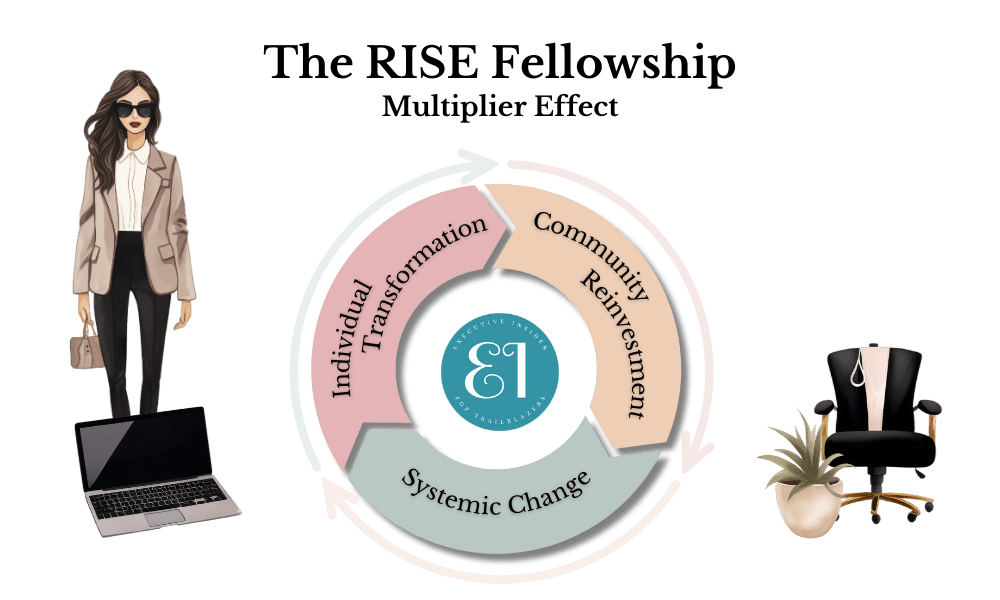
At Executive Insider, that’s the whole point of Closing the GAP™. We’re not asking women to carry the whole burden of advancement alone. We’re naming the structures that shape career mobility and helping FGPs build the internal and external scaffolding to move forward.
Your Next Step
Identify one place where your self-efficacy is being shaped by environment, not ability, and take one action this week to strengthen your support, visibility, or voice.
Sources
Bonesso, S., & Cortellazzo, L. (2025). A journey into women’s managerial career development through the social cognitive career lens. European Management Journal, 43(6), 980–990. https://doi.org/10.1016/j.emj.2024.10.006