If you’re a first-generation professional, you’ve likely spent your career mastering the “how.” How to write the perfect report. How to run a flawless analysis. How to be the most reliable person on the team. Your hard work and grit have gotten you this far.
But a seismic shift is happening in the workplace, and it’s changing the rules of the game. As artificial intelligence begins to automate the very tasks we once built our reputations on, a pressing question emerges: what becomes of our competitive edge?
The answer, according to the most powerful women in business, isn’t a more complex algorithm. It’s a deeply human skill: judgment.
At a recent Fortune summit, leaders like Tan Su Shan of Singapore’s DBS Bank and Beth Ford of Land O’Lakes highlighted that the future of AI is about heart and human-centricity (Antelo, 2025). But they also sounded a critical alarm. Aashna Kircher of Workday put it bluntly: “I don’t think that we are thoughtfully enough educating people about how to be good at judgment.”
For us as first-gen women, this isn’t just another trend to watch. It strikes at the heart of the invisible disadvantages we navigate every day.
The Judgment Gap: Our Unseen Hurdle
You’ve felt it. That moment in a meeting when a decision is made, and you’re not entirely sure how the consensus was reached. It’s the unspoken network of cues, context, and confidence that those with inherited social capital absorb effortlessly.
This is the judgment gap. It’s knowing not just what to do, but when to do it, why it matters, and what the long-term implications are. As AI takes over more routine data processing, the premium on this skill is skyrocketing. The best professionals won’t only deploy AI tools but will know when to trust them, when to challenge them, and how to interpret their outputs within the broader mission.
This is where our first-gen perspective becomes our greatest asset, not a liability. Our journeys have forced us to be adept navigators, to read between the lines, and to make high-stakes decisions with limited guidance. We already have a foundation of resilience and contextual understanding. The next step is to consciously cultivate and apply it at a strategic level.
Your First-Gen Resilience is Your AI Co-Pilot
The women breaking ceilings in tech aren’t just coders; they are leaders who understand people. Su Shan, the first female CEO in the history of DBS, isn’t just building AI models; she’s building a bank with a “heart” (Antelo, 2025). This requires a deep understanding of human need—a skill we first-gen women have in spades.
We understand nuance, sacrifice, and community because we’ve lived it. This lived experience is the bedrock of the judgment that AI cannot replicate. It’s the ability to:
- Weigh ethical trade-offs that a model can’t quantify.
- Understand the cultural context behind a colleague’s hesitation.
- Bring empathy to a difficult decision that affects people’s livelihoods.
The call from the summit is clear: ground yourself in the fundamentals. Bijal Shah, CEO of Guild, noted that a strong foundation in critical thinking and comprehension is irreplaceable (Antelo, 2025). For us, this means doubling down on our strategic skills. It’s not about out-coding the AI; it’s about out-thinking it with the wisdom our unique paths have granted us.
From Trapped in the GAP™ to Leading with AI
So, how do we close this “judgment gap” and embrace this new era of leadership?
- Reframe Your Relationship with AI: Stop seeing it as a threat to your hard-won technical skills. Start seeing it as the most powerful assistant you’ve ever had—one that handles the computational work, freeing up your mental energy for the high-judgment, high-impact strategic work that gets you noticed and promoted.
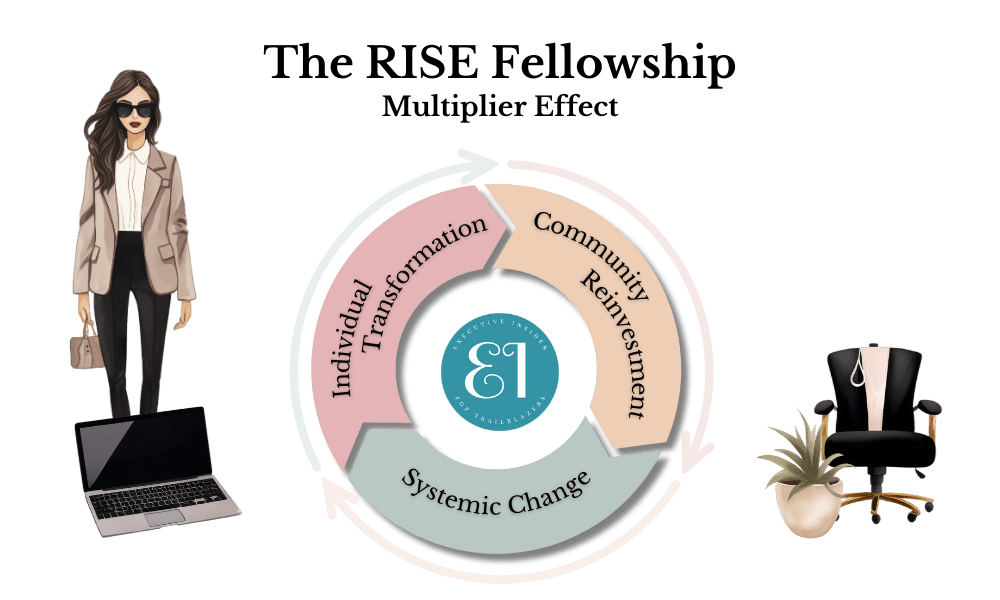
- Get Hands-On, Not Intimidated: The article notes that 70% of workers are already using AI tools. You cannot afford to be left behind. This isn’t about getting a computer science degree. It’s about gaining functional literacy. How can AI help you draft communications, analyze data sets, or manage your energy? At Executive Insider, we weave AI mastery into every tier of the RISE Fellowship for this exact reason—it’s a core tool for modern leadership.
- Activate Your Community: The representation gap is real, but that’s why our community is vital. Judgment is often honed through dialogue and mentorship. Seek out other women, both within and beyond your organization, to pressure-test your ideas and strategies. Build your own “inner circle,” as the research from Yang et al. (2019) prescribes.
The professional world is at a crossroads, and first-generation female professionals are uniquely positioned to lead the way. We have the resilience, the perspective, and now, the clarion call from the top: the future belongs to those who can lead with both intelligence and insight.
Your journey has already equipped you with a form of judgment that is rare and valuable. Now it’s time to trust it, hone it, and pair it with the tools of tomorrow. That is how we don’t just navigate the AI revolution—we shape it.
Sources
Antelo, P. U. (2025, November 13). Here’s what the most powerful women in business advise about the rise of AI. SUCCESS. https://www.success.com/powerful-women-in-business-ai