The Unseen Bias in AI: Why First-Gen Women Can’t Afford to Ignore the Warning Signs

by | Nov 27, 2025 | Artificial Intelligence (AI), Female Leadership

We often assume machines are neutral, but they are built by humans and trained on our biased world. Trailblazing women in tech have been warning us for years: AI systems are riddled with gender and racial bias. For first-gen female professionals, understanding this isn't a technicality: it's a critical career survival skill.

As AI transforms hiring, promotions, and daily work, trusting it to be objective is a dangerous gamble. The work of trailblazers like Joy Buolamwini, Timnit Gebru, and Rumman Chowdhury (Buolamwini, 2019) shows a system flawed at its core—a system that, if left unchecked, could systematically undermine the careers of women of color and first-gen professionals.

The “Coded Gaze”: When Technology Doesn’t See You

Buolamwini’s (2019) research at MIT uncovered the “coded gaze.” She found that facial recognition software from giants like IBM and Microsoft failed to detect her dark-skinned face unless she wore a white mask. This wasn’t an anomaly; it was a symptom. These systems were trained overwhelmingly on images of light-skinned men.

The consequences are stark:

  • Error rates for darker-skinned women soared to over 35%.
  • Systems consistently misgendered Black women, while accurately identifying white men.

This technical failure has human costs. It creates an “exclusion overhead”—the extra burden marginalized people bear to be seen and recognized by technology (Buolamwini, 2019).

From Faces to Futures: How Bias Scales

This bias isn’t confined to facial recognition. Gebru’s research into large language models (the foundation of tools like ChatGPT) found they perpetuate and amplify societal stereotypes.

  • Prompts like “the woman worked as” generated derogatory associations, but “the man worked as” did not.
  • These biased models are then applied to predictive analytics for hiring, loan applications, and even criminal sentencing.

The lack of diversity in the teams building AI and the data used to train it has created technology optimized for a narrow slice of humanity. As Gebru found, when you are not at the table, you are on the menu.

Your Role as a First-Gen Leader: From Awareness to Action

This is not a remote, technical problem. It’s a workplace reality. So, what can we do?

  1. Become AI-Literate, Not Just a User: Understand that AI outputs are suggestions, not truths. Question the data and the potential biases behind the tools your company uses.
  2. Advocate for Transparency: Support the work of leaders like Chowdhury, who push for systems to be audited and opened for analysis. In your organization, ask questions about how AI tools are vetted for bias.
  3. Leverage Your Unique Perspective: Your experience as a navigator of complex systems gives you a critical eye for when something is unfair or “off.” This is a form of judgment AI lacks. Use your voice to challenge biased outcomes.

The warnings from these women are not abstract. They are a call to action for every professional who cares about equity. By understanding the landscape, we can switch from being passive subjects of technology to active shapers of a more ethical future.

Sources

Buolamwini, j. (2019, February 7). Artificial intelligence has a problem with gender and racial bias. Here’s how to solve it. TIME. https://time.com/5520558/artificial-intelligence-racial-gender-bias

<a href="https://www.executiveinsider.org/author/blogauthor19/" target="_self">EI Insights Blog</a>
EI Insights Blog
As co-founder of Executive Insider, Torah Bontrager brings a unique blend of entrepreneurial, nonprofit, and AI expertise to her work, focused on overcoming the challenges faced by first-generation professionals (FGPs). She architects the holistic infusion of artificial intelligence throughout the RISE curriculum's pedagogy. As co-founder of Executive Insider, May Teo is an educator, mentor, and curriculum designer dedicated to advancing the careers of First-Generation Female Professionals. She leads the development of the RISE curriculum, a multi-tiered leadership pathway that equips women to transition from survival mode to visible, impactful leadership.

Hi First Generation Female Professional!

Are You Trapped in the GAP™?

Join our community of trailblazing women

. . . where we celebrate diversity and welcome your unique perspective.

Related Posts

The Cohort-Based RISE Fellowship

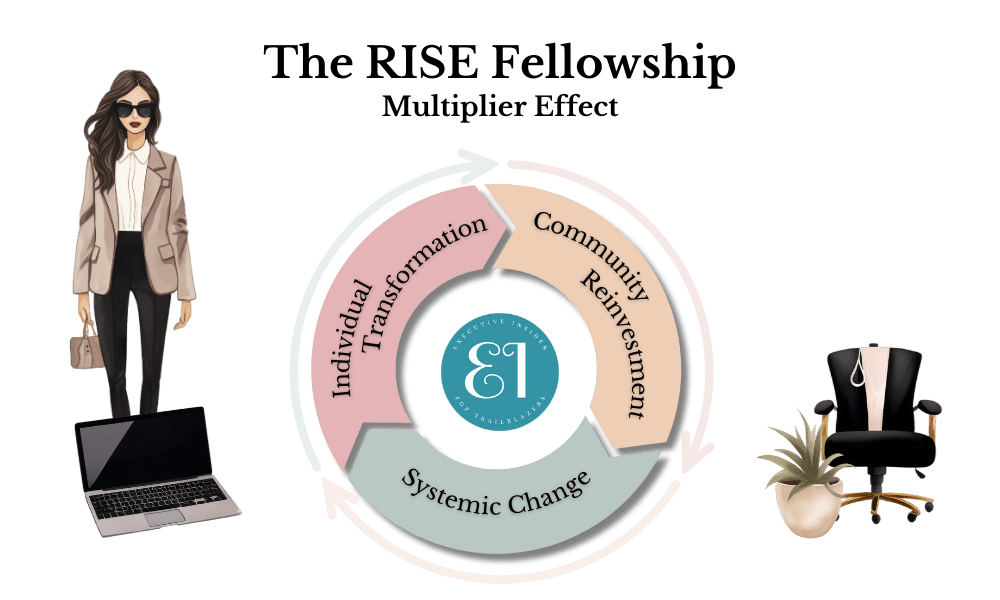
Our 18-month RISE Fellowship is a four-phase journey that transitions FGPs from career survival to sustainable leadership and legacy. Through sequenced curricula in Career Ownership, Strategic Navigation, Leading with Impact, and Community Building, we provide the critical support needed at every stage of a first-generation female professional's career.

Our fellowship is not a one-time course but a sustained journey. Each tier builds upon the previous to facilitate lasting transformation.

GOAL: TRANSITION FROM GRATEFUL WORKER → CAREER CEO

Tier 1: RISE Foundation Curriculum (Career Ownership)

This 90-day tier equips FGPs with the confidence, tools, and energy strategies to claim ownership of their careers. Every module leverages AI, teaching Fellows how to use artificial intelligence for energy stewardship and to reduce invisible labor.
GOAL: TRANSITION FROM EARLY PROFESSIONAL → STRATEGIC NAVIGATOR

Tier 2: RISE Advancement Curriculum (Strategic Navigation)

This 90-day tier equips FGPs to navigate politics, gain sponsorship, and practice strategic visibility in professional arenas. Every module leverages AI, teaching Fellows how to use artificial intelligence to simulate high-stakes environments, analyze complex networks, and refine strategic communication to build confidence before real-world execution.
GOAL: TRANSITION FROM STRATEGIC NAVIGATOR → VISIBLE LEADER WHO SHAPES SYSTEMS

Tier 3: RISE Leadership & Legacy Curriculum (Leading with Impact)

This 90-day tier equips FGPs to embrace leadership roles, mentor others, and design careers with lasting impact. Every module leverages AI, teaching Fellows how to use artificial intelligence to refine their leadership voice, model sustainable practices, and prototype systemic change, validating that their impact is both profound and enduring.
GOAL: TRANSITION FROM LEADER → TRAILBLAZER & COMMUNITY BUILDER

Tier 4: RISE Trailblazer Alumni Curriculum (Community Builders)

This 90-day tier equips FGPs to serve as mentors, advocates, and ambassadors who strengthen the ecosystem for future FGPs. Every module leverages AI, teaching Fellows how to use artificial intelligence to scale their mentorship, amplify their advocacy, and safeguard their sustainability, positioning their legacy to create a lasting cycle of empowerment for the next generations.

Fully-Funded by Our Generous Partners

Thanks to the support of our grantmakers and sponsors, the RISE Fellowship is offered at no cost to all selected FGPs, facilitating equitable access and opportunity for every Fellow.

Program Impact

The RISE Fellowship is designed to deliver a measurable return on investment, transforming communities and individual careers and strengthening the talent pipeline with first-generation women (FGPs). Our layered evaluation strategy tracks both quantitative and qualitative outcomes, so we capture the full depth of each Fellow's journey through the 18-month pathway.

Cross-Tier Impact & Economic Mobility Metrics

Within one year of completing their Fellowship, we project that our Fellows will achieve tangible career milestones that directly contribute to closing the wage and opportunity gap:

Promotion & Raise Rate: Over 50% of Fellows will report a promotion, significant raise, or transition to a more advanced role.

Network Growth: 70% will report a measurable strengthening of their professional support network.

Confidence in Advocacy: 85% will report increased confidence in negotiating salary, promotions, and scope of work.