Visibility Isn’t Value: What Female Professionals Need to Advance Without Burning Out

by | Jan 15, 2026 | Artificial Intelligence (AI), Mindset

Women are still more likely to do the work that keeps organizations moving—without receiving the visibility they deserve. A recent workplace survey highlights how recognition practices continue to lag behind the reality of their contributions.

For first-generation female professionals (FGPs), the workplace often teaches a painful lesson early: being excellent doesn’t always mean being seen.

What the Article Actually Says

HiBob’s 2025 survey says women’s career advancement is still hindered by gaps in mentorship, upskilling, and inclusive attitudes, with only 46% of organizations offering programs to prepare women for future tech roles (Homer, 2025). It also finds that women are more likely than men to feel they need office visibility to prove their value, while men are more likely to link office presence to leadership visibility and promotion potential (Homer, 2025).

The article further shows that women report lower access to formal mentors, less confidence in manager evaluations, lower satisfaction with work-life balance, and stronger concerns about caregiving, burnout, and recognition gaps (Homer, 2025). In short, the article says women are facing a connected set of structural barriers: mentorship shortages, weak inclusion, limited flexibility, and reward systems that still don’t reflect their contributions.

How Gaps in Support Systems Keep Women Over-Explaining Their Work

HiBob’s 2025 survey shows that women’s career advancement is still hindered by gaps in mentorship, upskilling, and inclusive workplace attitudes, and that many women feel they need day-to-day visibility just to make sure their contributions aren’t missed (Homer, 2025).

That’s not a small thing. It shapes how you show up, how you work, and how much of yourself you spend trying to be legible to a system that should already be paying attention.

Women are less likely than men to have mentors, less likely to be offered future-focused tech training, and less likely to feel empowered in their workplaces (Homer, 2025). Only 22% of women in the survey reported receiving a promotion in 2024, compared with 34% of men, and women were also less likely to report pay raises and recognition (Homer, 2025). The report also says only 46% of organizations offer upskilling for automation and technology roles, which means many women are being left without the tools to move into the jobs the future is creating.

If you’re an FGP, that probably doesn’t surprise you. You’ve likely felt the pressure to over-communicate, over-deliver, or over-show up just to keep your work from disappearing into the background. And if you’re more seasoned—mid-career, senior, or nearing an executive transition—you may recognize a different version of the same pattern: lots of responsibility, not enough visibility, and too little investment in your growth.

The report is especially useful because it connects visibility to reward. Women in the survey were more likely to say they go into the office to make their work visible to colleagues and managers, while men were more likely to frame office presence as a route to leadership visibility (Homer, 2025). That difference matters. It suggests women are often trying to prevent invisibility, while men are trying to leverage presence. Those are not the same career starting points.

And then there’s flexibility. Nearly half of respondents preferred a four-day workweek, and 41% would switch employers for flexible hours (Homer, 2025). That’s not laziness. It’s a strategy. For women who are juggling caregiving, burnout, and the invisible labor that still isn’t equally shared, flexibility is often the difference between staying in the game and burning out of it.

Why This Matters for FGPs (First-Gen Female Professionals)

First, don’t confuse being visible with being valuable. Your value is in the quality of your judgment, your problem-solving, your leadership, and your ability to make complex things work. Second, document your wins in a way that doesn’t depend on memory or hallway chatter. Third, ask directly for mentorship, stretch opportunities, and sponsorship. The survey shows those systems still aren’t reaching enough women, which means asking isn’t extra—it’s necessary.

And if you’re at a stage where you’re thinking about longevity, not just the next promotion, this report makes the case for sustainable advancement. You shouldn’t have to choose between growth and balance. You shouldn’t have to choose between ambition and care.

That’s exactly where Executive Insider’s mission comes in. We’re not asking FGPs to work harder for visibility. We’re helping them build the scaffolding, language, and network that make advancement possible without self-erasure.

Your Next Step

Identify one place where you’ve been overextending for visibility, and replace it with one action that creates real leverage—an ask, a boundary, or a documented win.

Sources

Homer, N. (2025, February 13). US 2025 women professionals in the modern workplace. HiBob. https://www.hibob.com/research/us-2025-women-professionals-in-the-modern-workplace

<a href="https://www.executiveinsider.org/author/blogauthor19/" target="_self">EI Insights Blog</a>
EI Insights Blog
As co-founder of Executive Insider, Torah Bontrager brings a unique blend of entrepreneurial, nonprofit, and AI expertise to her work, focused on overcoming the challenges faced by first-generation professionals (FGPs). She architects the holistic infusion of artificial intelligence throughout the RISE curriculum's pedagogy. As co-founder of Executive Insider, May Teo is an educator, mentor, and curriculum designer dedicated to advancing the careers of First-Generation Female Professionals. She leads the development of the RISE curriculum, a multi-tiered leadership pathway that equips women to transition from survival mode to visible, impactful leadership.

Hi First Generation Female Professional!

Are You Trapped in the GAP™?

Join our community of trailblazing women

. . . where we celebrate diversity and welcome your unique perspective.

Related Posts

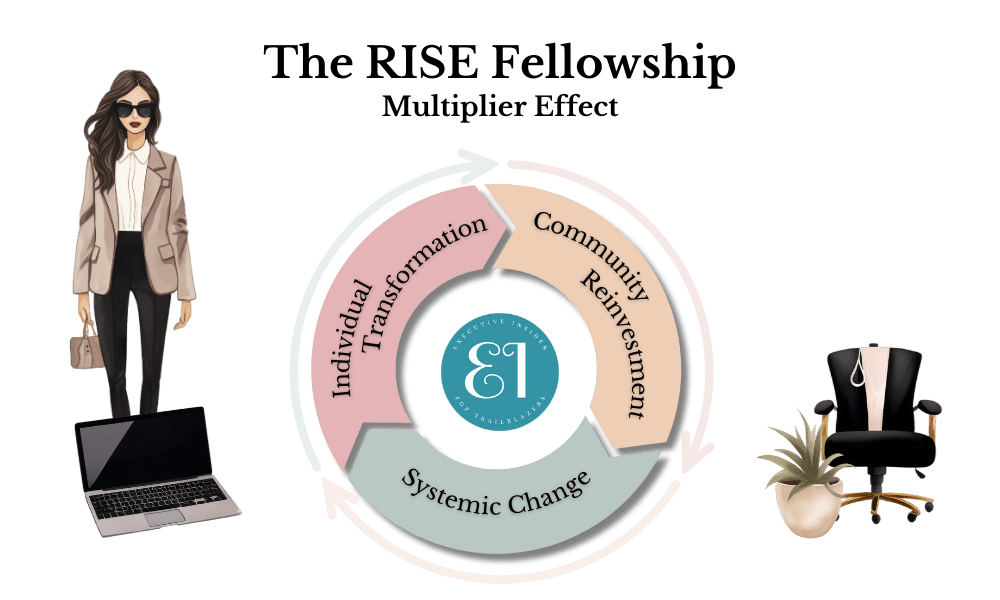
The Cohort-Based RISE Fellowship

Our 18-month RISE Fellowship is a four-phase journey that transitions FGPs from career survival to sustainable leadership and legacy. Through sequenced curricula in Career Ownership, Strategic Navigation, Leading with Impact, and Community Building, we provide the critical support needed at every stage of a first-generation female professional's career.

Our fellowship is not a one-time course but a sustained journey. Each tier builds upon the previous to facilitate lasting transformation.

GOAL: TRANSITION FROM GRATEFUL WORKER → CAREER CEO

Tier 1: RISE Foundation Curriculum (Career Ownership)

This 90-day tier equips FGPs with the confidence, tools, and energy strategies to claim ownership of their careers. Every module leverages AI, teaching Fellows how to use artificial intelligence for energy stewardship and to reduce invisible labor.
GOAL: TRANSITION FROM EARLY PROFESSIONAL → STRATEGIC NAVIGATOR

Tier 2: RISE Advancement Curriculum (Strategic Navigation)

This 90-day tier equips FGPs to navigate politics, gain sponsorship, and practice strategic visibility in professional arenas. Every module leverages AI, teaching Fellows how to use artificial intelligence to simulate high-stakes environments, analyze complex networks, and refine strategic communication to build confidence before real-world execution.
GOAL: TRANSITION FROM STRATEGIC NAVIGATOR → VISIBLE LEADER WHO SHAPES SYSTEMS

Tier 3: RISE Leadership & Legacy Curriculum (Leading with Impact)

This 90-day tier equips FGPs to embrace leadership roles, mentor others, and design careers with lasting impact. Every module leverages AI, teaching Fellows how to use artificial intelligence to refine their leadership voice, model sustainable practices, and prototype systemic change, validating that their impact is both profound and enduring.
GOAL: TRANSITION FROM LEADER → TRAILBLAZER & COMMUNITY BUILDER

Tier 4: RISE Trailblazer Alumni Curriculum (Community Builders)

This 90-day tier equips FGPs to serve as mentors, advocates, and ambassadors who strengthen the ecosystem for future FGPs. Every module leverages AI, teaching Fellows how to use artificial intelligence to scale their mentorship, amplify their advocacy, and safeguard their sustainability, positioning their legacy to create a lasting cycle of empowerment for the next generations.

Fully-Funded by Our Generous Partners

Thanks to the support of our grantmakers and sponsors, the RISE Fellowship is offered at no cost to all selected FGPs, facilitating equitable access and opportunity for every Fellow.

Program Impact

The RISE Fellowship is designed to deliver a measurable return on investment, transforming communities and individual careers and strengthening the talent pipeline with first-generation women (FGPs). Our layered evaluation strategy tracks both quantitative and qualitative outcomes, so we capture the full depth of each Fellow's journey through the 18-month pathway.

Cross-Tier Impact & Economic Mobility Metrics

Within one year of completing their Fellowship, we project that our Fellows will achieve tangible career milestones that directly contribute to closing the wage and opportunity gap:

Promotion & Raise Rate: Over 50% of Fellows will report a promotion, significant raise, or transition to a more advanced role.

Network Growth: 70% will report a measurable strengthening of their professional support network.

Confidence in Advocacy: 85% will report increased confidence in negotiating salary, promotions, and scope of work.