What AI’s Environmental Footprint Means for the Women Leading Change

by | Jan 8, 2026 | Community Engagement, Responsible AI

A wildlife-conservation deep dive shows that AI's data center boom is straining water supplies, disrupting ecosystems, and outpacing the transparency needed to hold anyone accountable.

If you’re the first in your family to sit at this table, you might also be the first to notice when growth and responsibility aren’t moving at the same pace. That noticing is leadership.

What the Article Actually Says

Kandasamy reports that as AI use grows, so does the fleet of data centers powering it, and that growth is straining energy grids, water supplies, and ecosystems in ways that go beyond carbon emissions (Kandasamy, 2025). The article cites the International Energy Agency’s projection that global data center electricity use will more than double to 945 terawatt-hours by 2030, and it notes that a single data center might use up to 5 million gallons of water a day, roughly what a town of 50,000 people uses.

The piece also broadens the conversation past emissions to include light and noise pollution, quoting researchers who describe data centers as potential “sensory danger zones” for wildlife, and it introduces the concept of “health-informed AI,” which weighs human health impacts, not just carbon output, when siting a data center (Kandasamy, 2025). The article closes by stressing that transparency around energy use remains limited, which makes independent verification of these harms difficult.

Beyond the Server: Women Leading Change

Kandasamy’s reporting makes a subtle but important shift: this isn’t just about carbon anymore. It’s about water tables, wildlife behavior, and whether communities even get the data they need to ask hard questions (Kandasamy, 2025).

For first-generation female professionals (FGPs), this matters because it reframes AI literacy as something broader than knowing how to prompt a chatbot. It’s about understanding the full weight of the systems behind the tools you’re increasingly asked to adopt, recommend, or manage at work.

What This Means for You, Right Now

If you sit anywhere near sustainability, operations, communications, or strategy in your organization, this article gives you language you might not have had before. “Health-informed AI,” a term researcher Shaolei Ren uses in the piece, describes weighing human health costs alongside carbon costs when deciding where infrastructure gets built (Kandasamy, 2025). That’s a concrete, defensible standard you might bring into a planning conversation.

This applies whether you’re 2 years into your career or 20. Early-career FGPs building credibility can use this framing to ask smart, well-informed questions in meetings, the kind that show you’re thinking several steps ahead of the immediate task. Mid-to-late-career FGPs moving into oversight or executive roles can use it to push for the transparency the article says is still missing; you don’t need to be a data scientist to insist that energy and water use get reported clearly.

Why This Matters for FGPs (First-Gen Female Professionals)

This source fits Executive Insider’s mission because it connects AI literacy directly to community reinvestment and systemic accountability, both pillars of our theory of change. The article’s core tension, rapid AI growth outpacing the transparency needed to manage its costs, is exactly the kind of invisible systemic barrier we exist to help you name and navigate.

We know you don’t have the luxury of assuming someone else is asking these questions. If you’re the first in your family to sit at this table, you might also be the first to notice when growth and responsibility aren’t moving at the same pace. That noticing is leadership.

Your Next Step

The next time your organization discusses adopting or expanding AI tools, ask one grounded question inspired by this research: what do we know about the energy and water footprint of this system, and is that information publicly available? If the answer is “we don’t know,” you’ve just identified a gap worth raising, and that’s exactly the kind of judgment call that moves you from task-executor to strategic voice.

Sources

Kandasamy, A. (2025, September 24). More data centers, more environmental problems? National Wildlife Federation. https://www.nwf.org/Magazines/National-Wildlife/2025/Fall/Conservation/AI-Data-Centers

<a href="https://www.executiveinsider.org/author/blogauthor19/" target="_self">EI Insights Blog</a>
EI Insights Blog
As co-founder of Executive Insider, Torah Bontrager brings a unique blend of entrepreneurial, nonprofit, and AI expertise to her work, focused on overcoming the challenges faced by first-generation professionals (FGPs). She architects the holistic infusion of artificial intelligence throughout the RISE curriculum's pedagogy. As co-founder of Executive Insider, May Teo is an educator, mentor, and curriculum designer dedicated to advancing the careers of First-Generation Female Professionals. She leads the development of the RISE curriculum, a multi-tiered leadership pathway that equips women to transition from survival mode to visible, impactful leadership.

Hi First Generation Female Professional!

Are You Trapped in the GAP™?

Join our community of trailblazing women

. . . where we celebrate diversity and welcome your unique perspective.

Related Posts

The Cohort-Based RISE Fellowship

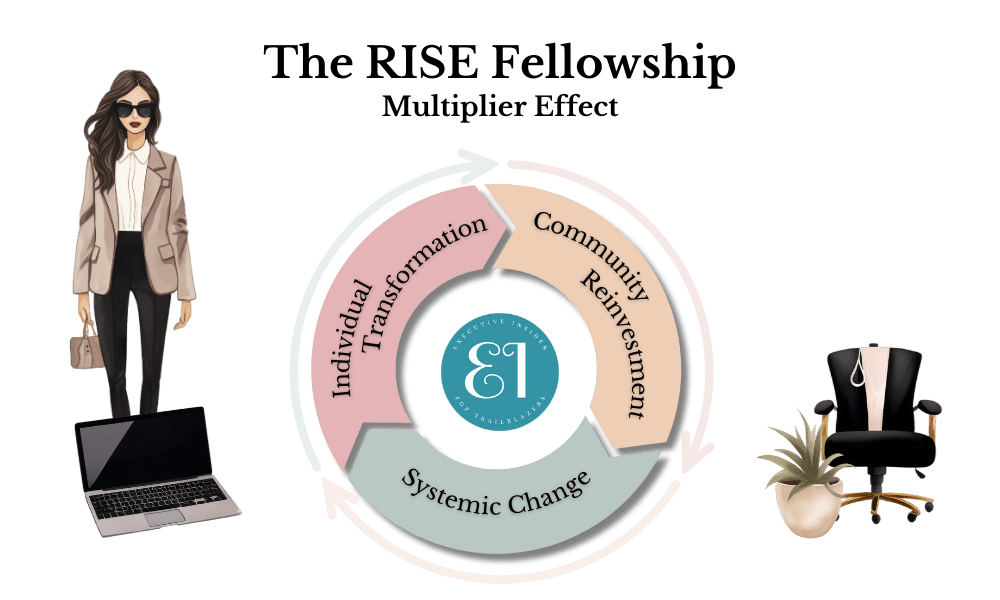
Our 18-month RISE Fellowship is a four-phase journey that transitions FGPs from career survival to sustainable leadership and legacy. Through sequenced curricula in Career Ownership, Strategic Navigation, Leading with Impact, and Community Building, we provide the critical support needed at every stage of a first-generation female professional's career.

Our fellowship is not a one-time course but a sustained journey. Each tier builds upon the previous to facilitate lasting transformation.

GOAL: TRANSITION FROM GRATEFUL WORKER → CAREER CEO

Tier 1: RISE Foundation Curriculum (Career Ownership)

This 90-day tier equips FGPs with the confidence, tools, and energy strategies to claim ownership of their careers. Every module leverages AI, teaching Fellows how to use artificial intelligence for energy stewardship and to reduce invisible labor.
GOAL: TRANSITION FROM EARLY PROFESSIONAL → STRATEGIC NAVIGATOR

Tier 2: RISE Advancement Curriculum (Strategic Navigation)

This 90-day tier equips FGPs to navigate politics, gain sponsorship, and practice strategic visibility in professional arenas. Every module leverages AI, teaching Fellows how to use artificial intelligence to simulate high-stakes environments, analyze complex networks, and refine strategic communication to build confidence before real-world execution.
GOAL: TRANSITION FROM STRATEGIC NAVIGATOR → VISIBLE LEADER WHO SHAPES SYSTEMS

Tier 3: RISE Leadership & Legacy Curriculum (Leading with Impact)

This 90-day tier equips FGPs to embrace leadership roles, mentor others, and design careers with lasting impact. Every module leverages AI, teaching Fellows how to use artificial intelligence to refine their leadership voice, model sustainable practices, and prototype systemic change, validating that their impact is both profound and enduring.
GOAL: TRANSITION FROM LEADER → TRAILBLAZER & COMMUNITY BUILDER

Tier 4: RISE Trailblazer Alumni Curriculum (Community Builders)

This 90-day tier equips FGPs to serve as mentors, advocates, and ambassadors who strengthen the ecosystem for future FGPs. Every module leverages AI, teaching Fellows how to use artificial intelligence to scale their mentorship, amplify their advocacy, and safeguard their sustainability, positioning their legacy to create a lasting cycle of empowerment for the next generations.

Fully-Funded by Our Generous Partners

Thanks to the support of our grantmakers and sponsors, the RISE Fellowship is offered at no cost to all selected FGPs, facilitating equitable access and opportunity for every Fellow.

Program Impact

The RISE Fellowship is designed to deliver a measurable return on investment, transforming communities and individual careers and strengthening the talent pipeline with first-generation women (FGPs). Our layered evaluation strategy tracks both quantitative and qualitative outcomes, so we capture the full depth of each Fellow's journey through the 18-month pathway.

Cross-Tier Impact & Economic Mobility Metrics

Within one year of completing their Fellowship, we project that our Fellows will achieve tangible career milestones that directly contribute to closing the wage and opportunity gap:

Promotion & Raise Rate: Over 50% of Fellows will report a promotion, significant raise, or transition to a more advanced role.

Network Growth: 70% will report a measurable strengthening of their professional support network.

Confidence in Advocacy: 85% will report increased confidence in negotiating salary, promotions, and scope of work.